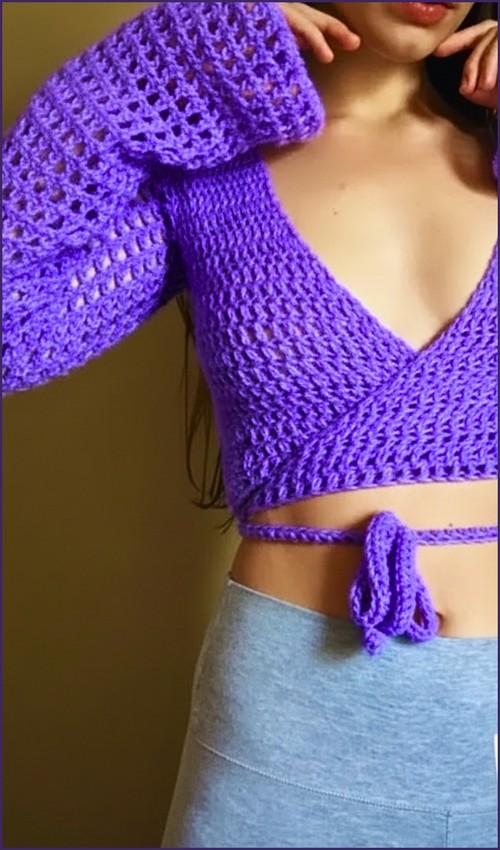
Flower details on crochet tops usually come as appliqués this one builds the flower directly into the fabric as a cut-out, so the bloom is structural, not decorative. The navy body frames it cleanly, and the open petal ring at centre front gives the whole top its focal point. If you like florals in crochet, the flower motif top takes a different approach worth seeing side by side.
Flower Cut-Out Crochet Top Pattern

The construction is more straightforward than the finished look suggests: a solid single crochet body with a granny circle worked separately and set into the front opening. The tie detail at the waist adds just enough shaping without extra shaping rows. For another cut-out top with a motif centre, the cut-out heart top is a close cousin worth bookmarking next.
Materials & Tools
- 4 mm or 5 mm crochet hook
- Acrylic or wool blend yarn (see yarn notes below)
- Scissors
- Yarn needle
Hook size note: The two hook sizes given produce noticeably different results. A 4 mm hook gives a tighter, more structured fabric — better for holding the square shape. A 5 mm hook gives more drape in the skirt. Consider starting with 4 mm for the square and switching to 5 mm for the skirt if you want that contrast.
Stitch Cheat Sheet
Technique Notes
Triple Treble Crochet (trtr)
The flower center is built on triple treble crochets — tall stitches that form the spokes radiating out from the starting chain. If you’ve worked treble crochets before, this is the same idea extended further: yarn over four times before inserting your hook, then work off loops in pairs until one remains. The height is what creates the open spoke-and-chain structure at the center of the flower.
Practice one or two into a scrap chain before you start — once the rhythm clicks, they work up quickly.
Working into the Back Loop of a Spoke
After filling the chain spaces with the petal sequence, you’ll work one double crochet into the top back loop of each spoke. This step anchors the petals and creates a clean edge for the rounds that follow. Look for the back loop at the top of each triple treble — it sits slightly behind the stitch and can be easy to miss on a first pass. Inserting a stitch marker into each spoke top as you finish a petal helps you keep track.
Squaring Off a Circle
The transition from circle to square is the most interesting construction in this pattern. You’ll spend two rounds building stitch count evenly, then begin introducing corner clusters — groups of triple crochets worked into adjacent stitches — that push the fabric out into corners. The segments of single crochets, half double crochets, and double crochets between corners create the flat sides of the square. Once all four corners are established, the remaining rounds simply stack double crochets with a 3-stitch corner increase on every pass. Work on a flat surface occasionally to check that your square is lying flat and the corners are sitting at roughly equal angles.
Skirt Construction
The skirt isn’t worked from a traditional foundation — it begins with a chain long enough to span the back width and joins to the bottom of the square, creating a continuous bottom edge that you then work in the round. The gradual increases (every 20th stitch, every fifth round) keep the skirt from flaring dramatically while still adding enough ease for comfortable movement. If you want a fuller skirt, increase more frequently; for a straighter silhouette, increase less.
Reinforced Straps
Slip stitching back along the strap chain isn’t decorative — it creates a double-layered cord that holds its shape and won’t stretch out with wear. Keep your tension slightly looser on the return pass so the strap lies flat rather than curling.
The Pattern

Flower Center
Chain 16. Work a triple treble crochet into the first chain. Chain 9, then work another triple treble crochet into the same first chain. Continue this spoke-and-chain sequence until you have 6 spokes with 9-chain spaces between them. Slip stitch into the sixth chain of the starting chain to close the round.
- In each 9-chain space, work the following petal sequence: 2 double crochets, 1 half double crochet, 1 single crochet, 1 slip stitch, 1 single crochet, 1 half double crochet, and 2 double crochets.
- Work 1 double crochet into the top back loop of each spoke.
- Don’t let crochet patterns intimidate you! If you’re a beginner, the video tutorial below makes it super easy to follow along!
Turning the Circle into a Square

- Round 3: Work in double crochet, increasing evenly to reach 60 stitches.
- Round 4: Work in double crochet, increasing evenly to reach 72 stitches.
Begin squaring off: work 2 single crochets, 3 half double crochets, and 3 double crochets along the side. Create the first corner by working 3 triple crochets into one stitch, then 3 triple crochets into the next stitch. Mirror the corner on the other side with 3 double crochets, 3 half double crochets, and 2 single crochets. Repeat this corner sequence for all four sides.
Continue in double crochet rounds, working 3 double crochets into each corner stitch on every round. Repeat until the square is wide enough to cover the chest.
Skirt

- Chain a length that wraps across the back and meets the opposite bottom corner of the square. Join the chain to the square and work double crochets in the round along the bottom edge of the square and the chain.
- Increase the skirt by working 2 double crochets into every 20th stitch on every fifth round. Continue until the skirt reaches your desired length.
Edging and Straps
- Work a single crochet border around both side edges of the square and along the skirt opening.
- At one top corner of the square, chain 300 for the first strap. Slip stitch back along the entire chain to reinforce it.
- At the opposite top corner, chain 350 for the second strap. Slip stitch back along the chain.
- Thread both straps through the double crochet spaces along the back, then tie to secure.

Yarn Substitution Notes
The pattern calls for acrylic or wool blend, and the choice genuinely matters here given the scale of the project.
Acrylic is the practical option — machine washable, widely available, and forgiving if you need to pull back and redo sections. For a dress this size, that’s not nothing. Choose a smooth, consistent acrylic rather than a textured or bouclé yarn; the flower detail and corner construction rely on stitch definition.
Wool or wool blend gives better drape in the skirt and a softer hand against skin, but adds care requirements. Superwash wool is a good middle ground — the natural fiber quality with easier laundering.
Cotton isn’t called for but works well if you’re making this for warm weather and want breathability. Bear in mind that cotton is heavier than acrylic or wool at the same yardage, which can pull on the straps over a long day of wear. A cotton-acrylic blend handles this better than 100% cotton.
Whatever you choose, stick to a smooth DK or worsted weight with good stitch definition. This pattern has too much textural detail to work well in anything fuzzy or heavily textured.
Customization Ideas
Length: The skirt continues until you decide to stop, so this works as a cropped top, a mini dress, a midi, or a maxi. The increase rate stays the same regardless of length.
Square size: The chest panel grows until it covers the chest — that’s the instruction. Makers with a larger bust simply work more rounds before moving to the skirt. No modification needed beyond continuing.
Strap length: The two straps are different lengths by design (300 vs. 350 chains) so they can cross at the back and tie at different heights. If you want a symmetrical wrap, match the lengths. If you want them to tie at the front instead, extend both.
Color: This construction lends itself naturally to colorwork. The flower center in a contrast color with a neutral square and skirt reads beautifully. Alternatively, a gradient yarn in the skirt section adds visual movement without any extra effort.
FAQ
What skill level does this require? Comfortable intermediate. You need to be at ease with working in the round, comfortable with a range of stitch heights (up to triple treble), and willing to track stitch counts across the circle-to-square transition. It’s not a beginner project, but it’s not technically demanding — it’s more about patience and careful counting than complex technique.
How much yarn will I need? This varies significantly based on your finished size and skirt length. A short-top version in DK weight might use 400–600 yards; a full-length dress could easily need 1,200 yards or more. Work with a yarn that comes in large skeins or stock up on multiple skeins in the same dye lot before you start.
The straps are different lengths — is that intentional? Yes. The asymmetric lengths allow the straps to cross at the back and thread through at different heights, creating a wrapped, adjustable fit. If you want matching lengths, you can make both the same, but the design is intentionally asymmetric.