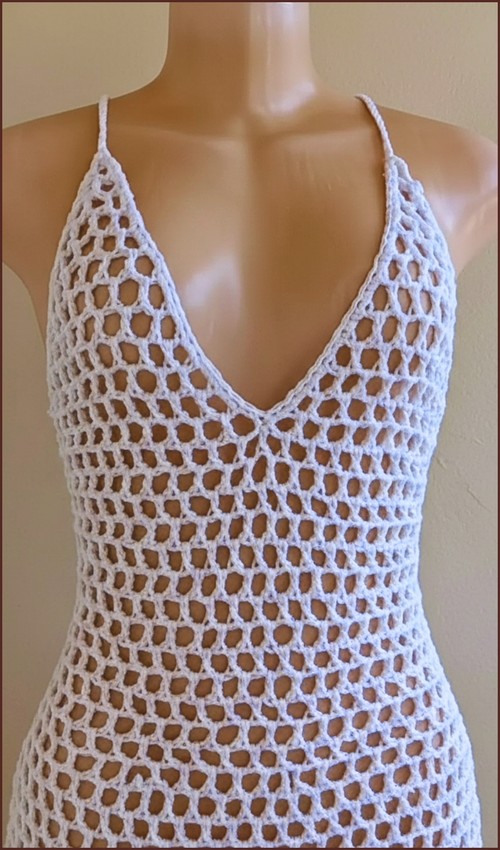
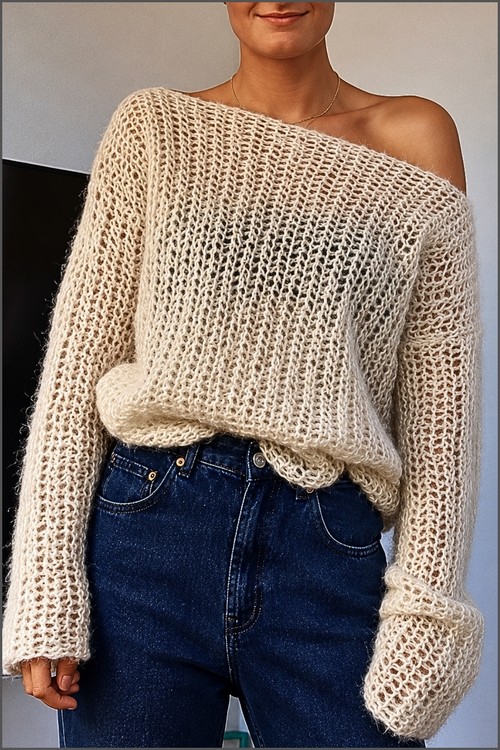
There’s a reason the off-shoulder mohair sweater never goes out of style, the halo of the yarn softens everything, and an oversized fit means it works draped, tucked, or belted depending on the day. This cream version works up in flat panels of single crochet that are seamed together, so the construction is deceptively simple despite the luxurious finished look. If the cozy oversized off-shoulder shape is what you’re after, the off-shoulder oversized crochet top covers a similar silhouette.
Crochet Oversized White Top

Working in mohair or a fluffy yarn does mean watching your tension carefully, the halo can make it tricky to see your stitches, so good lighting and a contrasting stitch marker help a lot. The panel construction keeps each piece manageable in size before you seam them, which is a nice advantage with a slippery yarn like mohair. For a lighter off-shoulder option in a non-fluffy yarn, the off-shoulder long sleeve crochet top is worth bookmarking alongside this one.
Why I love this one:
- That halo. In white, the brushed fiber catches light differently at every angle, and the oversized drape means it flatters almost every body without any shaping math whatsoever.
Materials and Tools
- Brushed alpaca, brushed mohair, or alpaca-silk blend yarn in Aran or Worsted weight — a yarn with a visible halo will give you the full effect
- 8 mm crochet hook
- Measuring tape
- Stitch markers or bobby pins
- Yarn needle
- Scissors
Difficulty and Time
Skill level: Beginner to confident beginner Estimated time: 5–8 hours Note: This is a genuinely accessible pattern. If you can work single crochet and sew a seam, you can finish this top. The only decisions you make throughout are based on your own measurements, not on following a fixed stitch count.
Stitch Cheat Sheet
Stitch Used
Single crochet, worked loosely throughout every section of this project. Loose tension is not optional — it is what gives the brushed yarn room to bloom and creates the drapey, soft quality that defines this top.
The Pattern
Front Panel
- Create a loose foundation chain based on your desired width, using the sizing reference as a guide.
- Work single crochet into the second chain from the hook and into every chain across the row.
- Chain one, turn, and work single crochet into every stitch across.
- Repeat this row until the panel reaches your desired length. For reference, a small size measures approximately 21.5 inches long.
- If you’re still learning how to read crochet patterns, no stress! Follow the video tutorial below and use the written pattern below as you get more comfortable!

Back Panel
- Create a loose foundation chain sized slightly wider than the front panel.
- Work the same single crochet rows as the front panel, maintaining the same loose tension throughout.
- Continue until the back panel measures approximately two inches longer than the front panel — this extra length creates the side split at the hem.
Sleeves — Make Two
- Create a loose foundation chain sized to your desired sleeve width.
- Work single crochet into the second chain from the hook and across the row.
- Chain one, turn, and continue working single crochet rows.
- Repeat until the sleeve reaches your desired length.
- Make two identical sleeve rectangles before moving to assembly.
Seaming the Shoulders
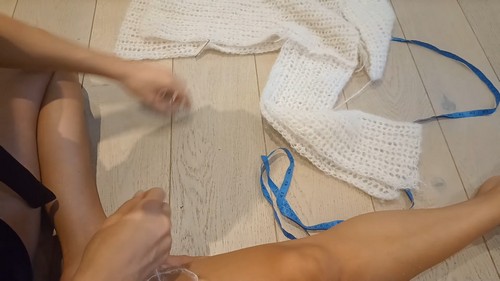
- Lay the front and back panels together with right sides facing each other and the stitches running horizontally across both pieces.
- Measure five inches inward from each top corner and mark with a stitch marker.
- Sew the panels together from each outer corner to the stitch marker on both sides, leaving a wide neckline opening between the two marked points.
Attaching the Sleeves
- Lay the joined body panels out flat.
- Find the center point of each sleeve rectangle and align it with the shoulder seam.
- Measure half the sleeve width outward from the shoulder seam in both directions and pin the sleeve edge in place.
- Sew the sleeve edge to the body panel along the pinned line.
- Repeat for the second sleeve.

Side Seams and Side Split
- Fold the sweater so right sides are facing inward.
- Measure down from the armpit and place a stitch marker at approximately the halfway point of the body panel to mark where the side split will end.
- Starting at the wrist, sew up along the sleeve to the armpit, then continue sewing down the body until you reach the stitch marker.
- Leave the seam open below the marker — this creates the side split.
- Repeat the same seaming on the opposite side.
Finishing
- Weave in all loose ends securely using the yarn needle.
- Turn the sweater right side out so all seams are concealed inside and the exterior is clean.
Tips
- Work your foundation chain with a hook one full size larger than your working hook. Brushed alpaca at a tight chain tension will fight you the entire first row. A larger hook for the chain alone fixes this immediately.
- Do not block this yarn before seaming. Brushed mohair and alpaca fibers shift when wet-blocked, and the halo can felt slightly if handled too much. Work with the fabric as-is and block only after the top is fully assembled if needed.
- Seam with a yarn needle and a strand of the same yarn rather than using a slip stitch crochet seam. The brushed fiber catches on itself during crochet seaming in a way that makes unpicking nearly impossible. The sewn seam is cleaner and far more forgiving.
- Check the side split placement before committing. Try the sweater on after folding and before sewing the side seams. Mark the split point while wearing it so the opening sits at a flattering spot on your body rather than being estimated from a flat surface.
Yarn Substitution
The yarn really does matter here. The entire visual character of this top — the halo, the softness, the way the white fabric glows — comes from a brushed fiber. A standard Aran acrylic will produce a completely different garment: denser, less drapey, without that romantic quality. If you cannot access brushed alpaca, look for a brushed mohair-acrylic blend or an alpaca-silk yarn, both of which produce a comparable halo effect. Avoid substituting with a non-brushed yarn unless you are intentionally going for a different aesthetic — it will not be the same top.
Customization Ideas
- Add color — this construction works equally well in cream, oatmeal, or any neutral. A tonal color lets the halo texture stay the focus.
- Extend the back panel further for a more dramatic side split, or shorten it to match the front for a split-free hem.
- Make the sleeves longer or shorter without any calculation — just work more or fewer rows before moving to assembly.
- Add a loose knot at the front hem to convert the oversized silhouette into a cropped front with a relaxed back tail.
FAQ
1. Can I use a different yarn weight than Aran or Worsted? You can, but the proportions will change. A bulky brushed yarn worked on a larger hook will give you a chunkier, warmer fabric that works beautifully in winter. A DK brushed mohair worked on a 6 mm hook will be lighter and more delicate. Whatever you choose, work a small tension swatch and measure it against your body measurements before cutting the full foundation chain.
2. The pattern says “desired width” and “desired length” throughout. How do I know what those measurements should be for me? Measure a top you already own and love the fit of. Lay it flat and measure across the chest for width and from shoulder to hem for length. Add a couple of inches to both for the oversized effect — this style is meant to drape, not to fit close to the body. The sleeve width is similarly personal: measure from your shoulder to your wrist for length, and around the fullest part of your upper arm for width reference.
3. My single crochet is coming out stiff and dense rather than drapey. What is wrong? Almost certainly your tension. This pattern specifically requires loose single crochet, and on a brushed yarn at Aran weight with an 8 mm hook, you should be working well below what feels like your normal tight tension. If the fabric does not drape easily when you hold it up, try loosening your grip on the yarn and allowing the stitch to form with less pull. It can feel unfamiliar at first, but loose single crochet on a large hook produces a fundamentally different fabric than standard tension.
4. Can I use bobby pins instead of stitch markers? Yes — the pattern lists them as an alternative for a reason. Bobby pins work well for holding seam placement and marking split points, and they grip the brushed yarn better than some plastic locking markers do. Either works perfectly for this construction.