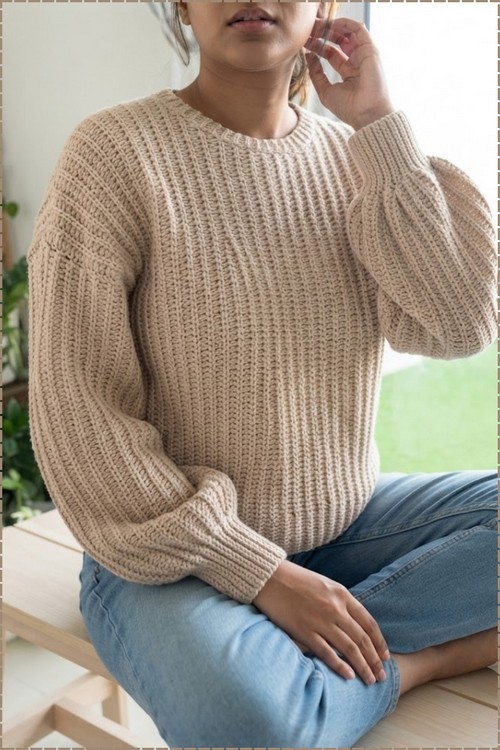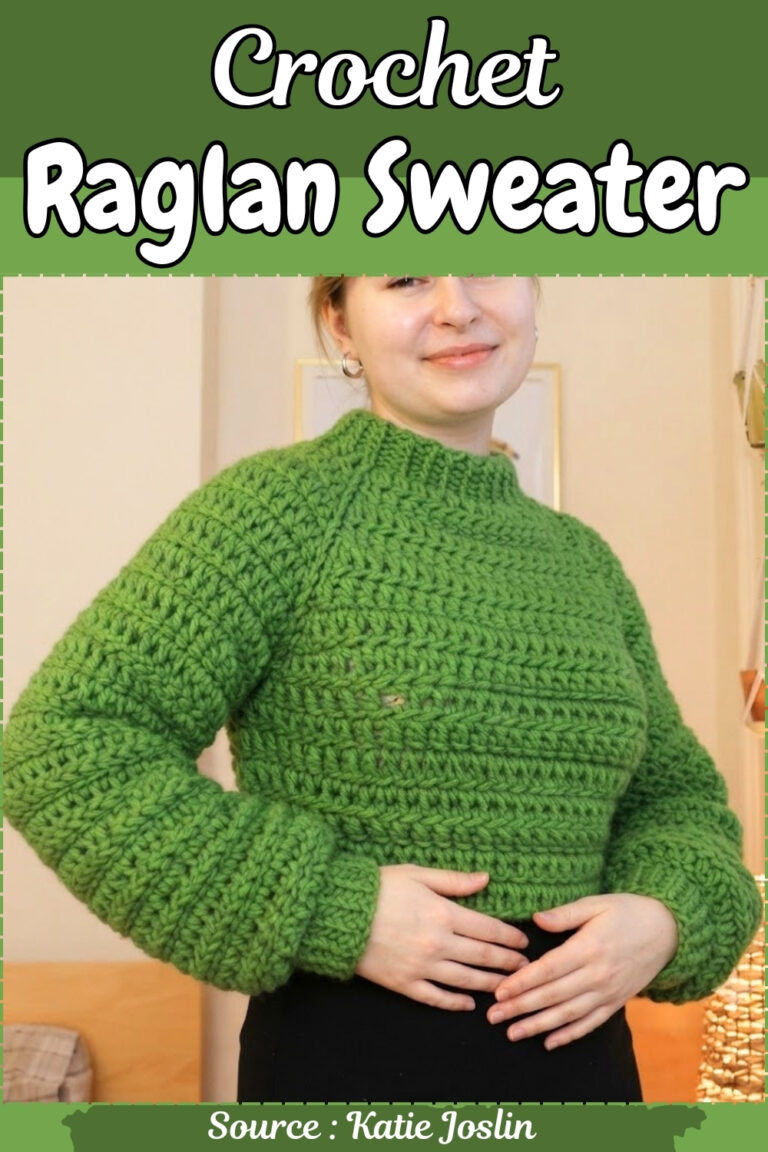
Soft pastel shades make the light pink mohair sweater an easy spring layer to tuck into light wash jeans or wear loose over a slip dress. Delicate gold necklaces sit nicely on the round neckline of the pastel pink crochet sweater, a sweet birthday gift idea.
Four rectangles, one stitch repeat, and a lace-weight mohair held double — that is the entire structure of this sweater. The moss stitch (alternating single crochet and chain-1 spaces) builds a semi-open fabric that mohair fills in with its halo, producing something that looks like a cloud you can wear.
Mohair Crochet Sweater Pink

Wide sleeves gathered at the wrist with ribbed cuffs give it the puffed silhouette that makes this design worth making in pink specifically, though any pale or saturated shade reads beautifully in this yarn. If you want a sweater with visible effort and minimal construction complexity, this is the one to reach for.
Materials and Tools
- Approximately 200g of lace-weight mohair yarn (a 62% mohair blend at around 500m per 50g works well); the yarn is held double throughout the entire project
- 9.0 mm crochet hook for the main body and sleeves
- 7.0 mm crochet hook for the cuffs and bottom ribbing
- Tapestry needle with a large eye
- 3 to 5 stitch markers
- Scissors
Sizing
This pattern is written for a Size S with an oversized fit. The finished body panels measure approximately 55 cm wide and 41 cm long.
To size up, add 10 chains to the body panel foundation for each size (Size M starts with 73 chains, Size L with 83). To size down, subtract 10 chains (Size XS starts with 53). The foundation chain must always be an odd number regardless of size — this is what keeps the moss stitch working correctly across every row.
Stitch Abbreviations
- ch: chain
- sc: single crochet
- sp: space
Mohair Moss Stitch Sweater Pattern
Body Panels — Make 2
Both the front and back panel are identical. The moss stitch is an alternating sequence of sc and ch-1 spaces. The pattern locks in on Row 2 and repeats without change from there. Work loosely throughout — mohair is difficult to unpick and a tight tension makes the fabric stiffer than it should be. Count your stitches at the end of every few rows to catch any drift early.

Foundation
- With the 9.0 mm hook and both strands of yarn held together, chain 63 loosely. (Add or subtract 10 chains per size; always keep the total odd.)
Moss Stitch Setup
- Work 1 sc into the 3rd chain from the hook.
- Ch 1, skip 1 chain, work 1 sc into the next chain.
- Repeat ch 1, skip 1, sc across to the end of the row. The final stitch is a sc worked into the last chain.
Moss Stitch Rows
- Ch 2 and turn.
- Work 1 sc into the very first ch-1 space from the previous row (the gap between the first two sc stitches).
- Ch 1, skip the next sc, work 1 sc into the next ch-1 space.
- Repeat ch 1, skip sc, sc into ch-1 sp across the row. The final sc of the row lands in the space between the last sc and the turning ch-2 from the row below.
- Repeat this row until you have completed 50 rows total. Fasten off.
- Make a second identical panel.
Sleeves — Make 2

The sleeves are intentionally wide — approximately 44 cm unfolded — so that gathering them into the ribbed cuffs creates the puffed-sleeve shape. The stitch pattern is identical to the body panels.
Foundation
- With the 9.0 mm hook and both strands held together, chain 53 loosely.
Moss Stitch Setup
- Work 1 sc into the 3rd chain from the hook.
- Ch 1, skip 1 chain, work 1 sc into the next chain.
- Repeat to the end of the row.
Moss Stitch Rows
- Ch 2 and turn. Work the moss stitch exactly as for the body panels.
- Continue for 50 rows total. Fasten off.
- Make a second identical sleeve.
Assembly

Shoulder Seams
- Lay the front and back panels flat on top of each other with stitches aligned.
- Using a tapestry needle and a double strand of yarn, seam each shoulder starting at the outer edge and working inward.
- For Size S, sew inward across 9 sc on each side, leaving the center section open for the neck. [Approximately 17–18 cm per shoulder seam]
Attaching the Sleeves
- Fold one sleeve in half lengthwise to find its center point.
- Align that center point with the shoulder seam and use 4 to 5 stitch markers to pin the sleeve edge along the side of the body panels.
- Sew the sleeve flat to the body. Repeat for the second sleeve.
Side and Underarm Seams
- Fold the entire sweater in half at the shoulders so the front and back panels lie together and the sleeves fold back on themselves.
- Sew a continuous seam beginning at the bottom hem of the body, running up the side, and continuing all the way down the underarm to the wrist.
- Repeat on the other side.
Cuffs and Bottom Ribbing

Switch to the 7.0 mm hook for all ribbing sections. The tighter hook pulls the wide oversized fabric in at the hem and wrists to give the sweater its shape.
- Attach yarn at the bottom hem or wrist edge.
- Work approximately 8 rows (around 5 cm) of ribbing along the bottom hem and around each sleeve cuff.
Yarn Substitution
Mohair is genuinely central to this sweater — the halo is what fills the open moss stitch gaps and creates the cloud-like opacity. Swapping to a standard DK or worsted yarn will give a completely different fabric: more defined, less dreamy, and without the semi-transparent layered look. If you cannot source a mohair blend, a silk-mohair or brushed alpaca held double in a similar weight will behave closest to the original. Stay away from cotton or smooth acrylic for this particular design — the stitch pattern needs the fuzzy bloom to read as intended.
Customization Ideas
- Work both strands in the same colorway for an even, tonal haze, or hold one strand in pale pink and one in white for a softer, more cloud-like blend.
- Adjust the sleeve width by changing the sleeve foundation chain to match the body sizing formula — wider for more drama, narrower for a standard sleeve.
- Add more rows to the body panels before assembling for extra length, or stop earlier for a cropped fit.
- Extend the ribbing to 10 or 12 rows for a more pronounced gathered effect at the hem and wrists.
Frequently Asked Questions
Why is the yarn held double? A single strand of lace-weight mohair at this hook size would produce a very open, almost transparent fabric. Holding two strands together builds enough density to make the sweater wearable while keeping the floaty, halo-heavy character of the yarn intact.
What if I lose my stitch count mid-row? This is the main practical risk with mohair — the fibers cling to each other and make tinking back painful. Work slowly on the first few rows until the moss stitch rhythm is automatic, and count at the end of every row rather than every few. If a mistake is deep enough that unraveling would destroy the yarn, a well-placed duplicate stitch can cover most surface errors.
Can I make the neck opening wider or narrower? Yes. The neck width is set by how many stitches you leave unseamed at the shoulder join. Seam fewer stitches inward on each shoulder for a wider neck, more stitches for a narrower one. Just keep both sides symmetrical.