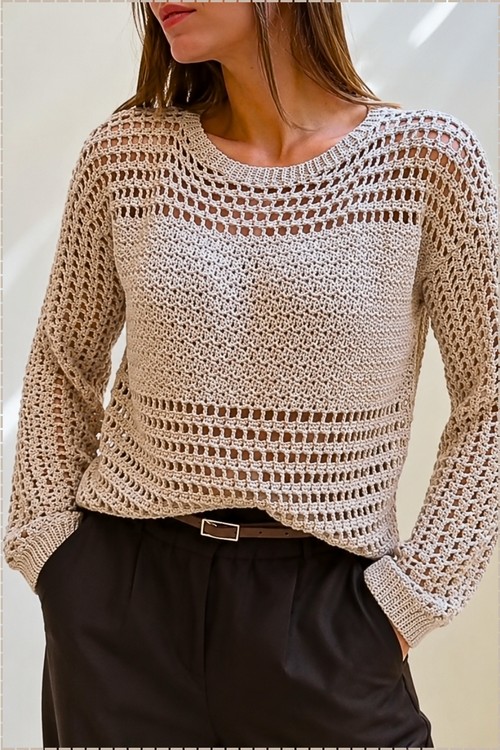
Anyone who dresses in neutrals for the office will reach for a crochet sweater in lightweight yarn that sits loosely over belted black trousers. Snug ribbed cuffs on the long sleeves stay put at a keyboard, so the crochet sweater for women works under an open blazer all week.
Sand beige in three distinct textures running in horizontal zones, open mesh at the yoke, a denser solid section through the chest and wide eyelet bands at the hem. Each zone uses the same yarn and the same hook but a different row structure, so the transitions happen by changing the repeat rather than by changing any materials. Readers who have made the long sleeve sweater on this site will recognize the construction immediately.
Crochet Sweater Pattern Lightweight Yarn
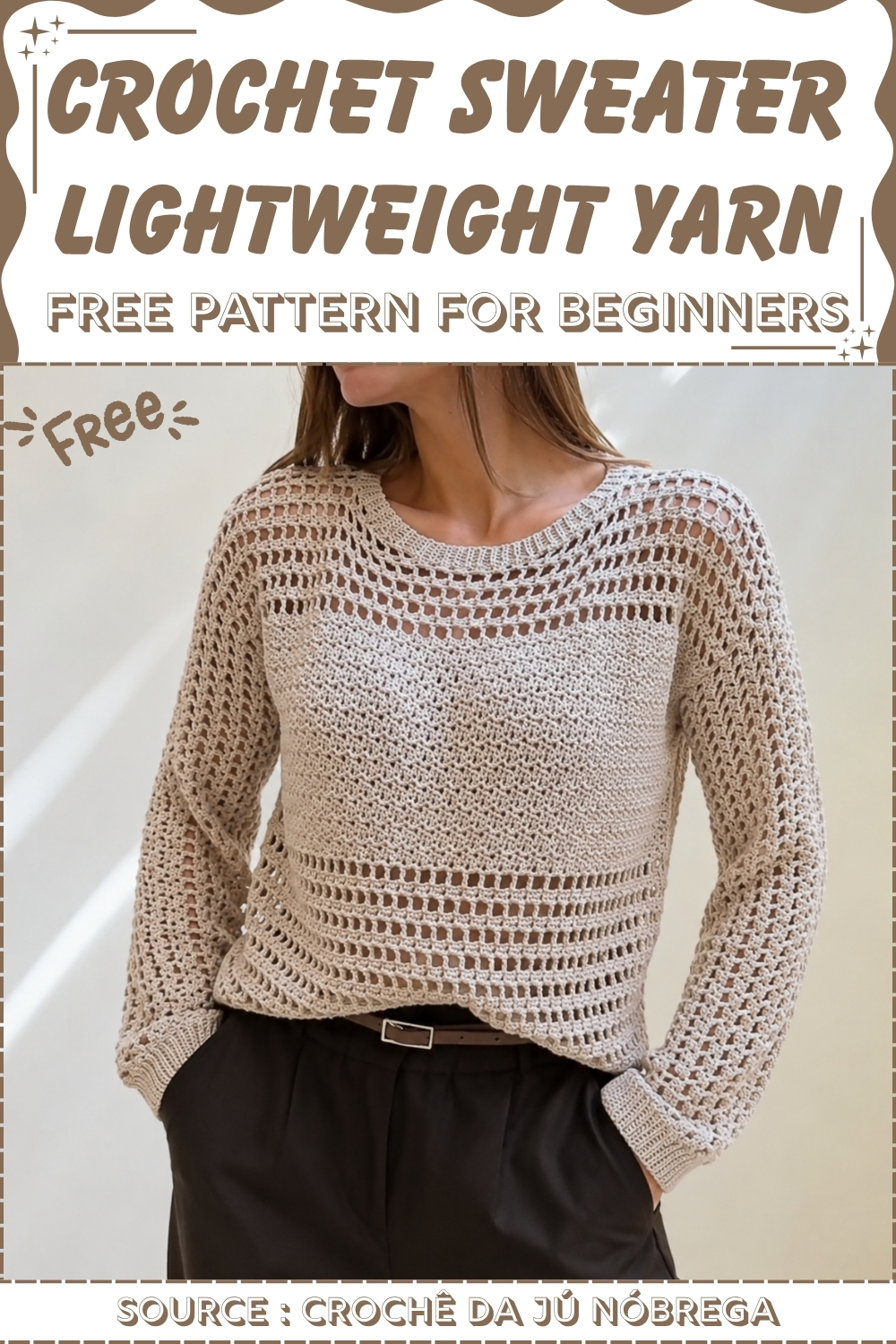
Three repeats alternate through the body in set row counts. The yoke rows chain more space than they fill, which creates the open look, the chest rows close those spaces down for a solid band, and the hem rows open again in a wider eyelet to flare slightly at the bottom edge. Panels are worked flat and seamed at the shoulders and sides, and the cuffs are added last as a tight rib to contrast with the airy body above.
Who This Is For
- You want a lightweight, breathable summer top rather than a warm sweater.
- You are comfortable working in joined rounds and reading chain spaces rather than individual stitches.
- You are patient with fine thread on a small hook. This is not a fast project.
- You are happy to work from your own measurements instead of a size chart.
What This Pattern Covers
This is the body of the blouse, worked in the round from the bust down to the finished hem. The armholes and upper shaping are continued in the creator’s follow-up tutorial, so what you will have at the end of these steps is a completed tube of roughly 27 cm, ready for that next stage.
Materials and Tools
- Clea thread used double, in color #7684, Porcelana. Note that the double Clea thread tends to stretch quite a bit.
- A 2.5 mm crochet hook.
- A tape measure.
- Scissors.
- A tapestry needle for finishing and weaving in ends.
- Size shown is Small.

Basic Crochet Stitch
Technique Notes, With the Tips Built In
- Measure for stretch, not for fit. This is the single most important decision in the whole project and it happens before your first stitch. The double thread grows noticeably once the fabric has weight in it, so the foundation chain is deliberately made shorter than the actual bust measurement. The creator chained to 72 cm for an 82 cm bust. If you chain to your true measurement, you will end up with a blouse that hangs loose and keeps dropping off one shoulder.
- Check the chain before you join. A twisted foundation chain is unfixable once joined, and on a round this long the twist is easy to miss. Lay the whole chain flat on a table, run your finger along the bottom edge to make sure every loop faces the same way, and only then slip stitch to close it.
- Learn to read the two rounds. The grid round is double crochet, chain 2, double crochet, chain 2, all the way around. The textured round puts a double crochet and a single crochet into each of those chain-2 spaces with a chain 1 between. The grid round looks sparse and the textured round looks solid. If you ever lose your place, just look at the last completed round and work the other one.
- Work into the chain, not the space, on the textured round. This pattern is specific about it: the double crochet goes into the first chain of the two-chain space and the single crochet goes into the second chain. That is what keeps the texture evenly distributed rather than bunched.
- Keep your tension consistent, not tight. Fine thread on a 2.5 mm hook tempts you to pull everything snug. Resist it. The drape in this blouse comes entirely from a relaxed hand, and a tight round will also make the next round’s chain spaces hard to find.
- Measure the body length frequently. You work the textured pattern to approximately 23 cm and then add about 4 cm of band for a total around 27 cm. Hold the fabric up and let it hang rather than laying it flat when you measure, because this yarn will read shorter flat than it will on a body.
The Pattern
Step 1: Foundation Chain Based on Bust Measurement
- Measure your bust with the tape measure.
- Because the double Clea thread stretches significantly, make your chain shorter than your actual bust measurement. For example, for an 82 cm bust, the creator chained 72 cm to account for stretching. [82 cm bust, 72 cm chain]
- Make a foundation chain matching your adjusted measurement.
- Ensure the chain is straight and not twisted before joining.
Step 2: Base Mesh and Grid Foundation, First Round
- After joining your foundation chain, chain 5, which counts as 1 double crochet plus 2 chain spaces. [5 ch]
- Skip 2 stitches on the base chain, and in the 3rd stitch make 1 double crochet, then chain 2. [1 DC, 2 ch]
- Repeat this around, skipping 2 stitches, working 1 double crochet, then chaining 2, for the entire round.
- Join with a slip stitch into the 3rd chain of your initial turning chain.

Step 3: The Main Textured Stitch Pattern
Positioning
- Slip stitch into the first chain of the 2-chain space.
Row Pattern
- Chain 3, which counts as 1 double crochet. [3 ch]
- In the next chain of the same space, make 1 single crochet. [1 SC]
- Chain 1. [1 ch]
- Skip the double crochet stitch from the previous row. In the next chain space, make 1 double crochet in the first chain and 1 single crochet in the second chain. [1 DC, 1 SC]
- Chain 1, and repeat this sequence of 1 double crochet plus 1 single crochet in the chain space followed by chain 1, all the way around the row.
Still getting the hang of reading crochet patterns? That’s completely okay, the video tutorial below breaks everything down in a simple, beginner-friendly way!
Closing the Round
- Join with a slip stitch to the top of the initial turning chain, then slip stitch into position for the next round.
Step 4: Alternating Rows and Repeating
Grid Row
- For the next round, chain 5, make 1 double crochet into the designated chain space, chain 2, and repeat around to recreate the grid base. [5 ch, 1 DC, 2 ch]

Textured Row
- Follow the alternating sequence of 1 double crochet, 1 single crochet, chain 1.
Body Length
- Continue alternating these rows to build the body of the blouse until you reach approximately 23 cm of this textured pattern, leaving room for the lower band or hem later. [23 cm]
Step 5: Lower Hem and Band
- Complete an additional 4 cm of border or band stitches at the bottom edge to reach a total length of roughly 27 cm, before moving on to the armholes and upper shaping. [4 cm, 27 cm total]

Yarn Substitution
The yarn is doing a lot here, and the stretch factor is specific to it, so substitute with care.
- Any fine cotton thread held double behaves most like the original. Keep the hook small and expect similar stretch.
- A single strand of sport or light DK cotton is the practical shortcut if holding two strands is fiddly. You will need a larger hook and the fabric will be slightly less fine, but the stitch pattern still reads clearly.
- Mercerized cotton gives a crisper, slightly shinier finish with excellent stitch definition, which suits this grid-and-texture fabric particularly well.
- Linen and linen blends drape beautifully for a summer top and soften with every wash.
- Avoid acrylic and wool here. The appeal of this blouse is coolness and a light, semi-sheer hand, and neither of those fibres delivers it at this weight.
- Avoid anything fuzzy. The alternating grid and texture rounds are the entire design, and fluff erases the distinction between them.
- Whatever you pick, work a short swatch in the round and hang it with a weight on it overnight. That tells you how much your yarn will grow, which is the number your foundation chain depends on.
Customization Ideas
- Length. The 23 cm of textured pattern plus a 4 cm band gives a cropped blouse. Keep alternating rounds for a longer top that sits at the hip.
- Band depth. A deeper band at the hem makes the bottom edge firmer and gives the blouse a more finished, structured line.
- Stripe the grid rounds. Changing color only on the open grid rounds gives a fine pinstripe effect without disturbing the textured bands.
- Wider or narrower fit. Your foundation chain measurement is the only thing setting the circumference. Going a little longer gives a relaxed, loose blouse rather than a close one.
- Lining. A simple slip underneath turns this from a layering piece into something you can wear on its own, since the fabric is openwork by design.
- Solid vs airy. More consecutive textured rounds make the fabric denser. More consecutive grid rounds make it lighter and more open. The alternation is the default, not a rule.
Frequently Asked Questions
Why is the foundation chain shorter than my actual bust measurement? Because the thread stretches once there is fabric weight hanging from it. A chain made to your true bust will produce a blouse noticeably wider than your bust by the time it is finished. The creator’s example, chaining 72 cm for an 82 cm bust, gives you a sense of how much allowance to make, but swatch your own yarn if you are substituting, since every thread grows differently.
Where are the sleeves and the neckline? This pattern covers the body of the blouse, worked in the round from the bust down to the finished hem at roughly 27 cm. The armholes and upper shaping are continued in the creator’s follow-up tutorial. What you will have at this point is a finished tube ready for that next stage.
Can I use a bigger hook to make this faster? You can, but it changes the garment. A larger hook on fine thread gives a much more open, sheer fabric with less body, and the stretch problem gets worse rather than better. If speed is the goal, switch to a thicker yarn on a correspondingly larger hook instead, so the ratio of yarn to hook stays sensible.