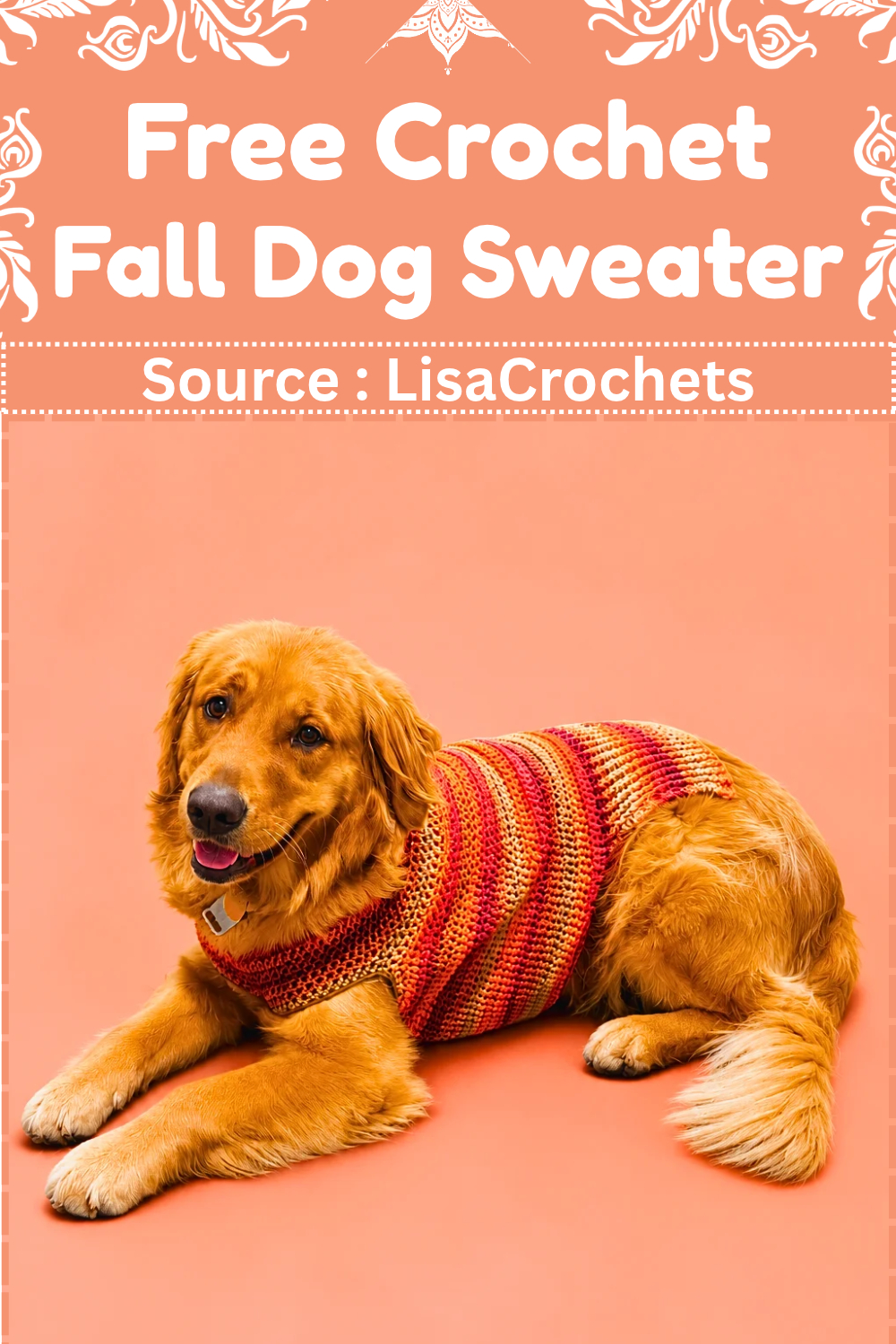
Autumn leaf walks get cozier for big dogs wearing this crochet fall dog sweater, with red, rust and orange stripes wrapping the back and chest. Golden retrievers and other large breeds wear the striped crochet dog pullover happily on chilly park outings and Thanksgiving visits.
The first frosty morning of October always catches my dog by surprise. She steps out onto the porch, stops dead, and looks back at me as if I personally arranged the weather. This crochet fall dog sweater is my answer to that look. It works up in a cinnamon swirl cake of medium weight acrylic on a 5.5 mm hook, so the colors drift from spice to cream all by themselves while you stitch. The sweater starts with a ribbed back flap, closes into a tube for the body, opens two leg holes, and tapers gently toward a snug ribbed collar.
Crochet Fall Dog Sweater
Half double crochet carries the whole project, which makes it a relaxed, rhythmic make once you settle in. Front and back post stitches give the flap and collar their stretchy ribbing, and a foundation half double crochet start keeps the first row from pulling tight the way a long chain can. The pattern gives the stitch counts from the sample, but every key number, from the width of the back panel to the decrease rounds at the neck, can grow or shrink to suit your pup. I have flagged the spots where a quick try on pays off, so you can stitch with confidence and finish with a sweater that truly fits.
Materials and Tools
- Caron Cinnamon Swirl Cakes (size #4 medium weight, 100% acrylic)
- 5.5 mm crochet hook
- Scissors
- Yarn needle
- Stitch marker, or a spare yarn needle for marking stitches
Abbreviations (US Terms)
- ch: chain
- sl st: slip stitch
- sc: single crochet
- hdc: half double crochet
- fhdc: foundation half double crochet
- fphdc: front post half double crochet
- bphdc: back post half double crochet
- hdc2tog: half double crochet two together (decrease)
Stitch Guide
- Foundation half double crochet (fhdc): Ch 2. YO, insert into the first ch, and pull up a loop (3 loops on hook). YO and pull through the first loop only (3 loops still on hook), then YO and pull through all 3 loops. For each following stitch, YO, insert under both strands of the V at the base of the previous stitch, pull up a loop, YO and pull through 1 loop, then YO and pull through all 3 loops.
- Half double crochet (hdc): YO, insert into the stitch, pull up a loop, then YO and pull through all 3 loops.
- Front post half double crochet (fphdc): YO, insert from front to back around the post of the stitch, pull up a loop, then YO and pull through all 3 loops.
- Back post half double crochet (bphdc): YO, insert from back to front around the post of the stitch, pull up a loop, then YO and pull through all 3 loops.
- Half double crochet two together (hdc2tog): YO, insert into the first stitch and pull up a loop, insert into the next stitch and pull up a loop, then YO and pull through all loops on the hook.
- Single crochet (sc): Insert into the stitch, pull up a loop, then YO and pull through both loops.
Difficulty and Time
This is an easy to advanced beginner project. If you can work hdc and keep count, you can make it; the post stitches are the only new move for many makers, and they repeat in a simple alternating rhythm. Expect a few cozy evenings for the sample size, with a little extra time if you pause to try it on at the leg holes and the neck, which I strongly recommend.
Beginner Technique Notes
- Why start with fhdc: Foundation stitches build the chain and the first row at the same time. The edge stays as stretchy as the rest of the fabric, which matters on a back flap that has to move with your dog.
- Post stitch ribbing: Working around the post instead of the top of the stitch pushes fphdc forward and bphdc back. Alternate them across every row and they stack into vertical ribs.
- Edge stitches: Every ribbing row begins and ends with a plain hdc. Those edge stitches keep the sides of the flap straight and give you a clean edge to join into.
- Turning in the round: Rounds 22 to 48 are joined and then turned. Turning keeps the hdc texture even on both sides and stops the seam line from spiraling around the body.
- Counting from the center: Before the leg holes, you fasten off and rejoin at the exact center of the underside. That way the leg openings land evenly on either side of the chest.
Fall Dog Sweater Crochet Pattern

Pattern Notes
- The sweater starts at the back with a ribbed flap worked flat, then joins into a tube and is worked toward the neck.
- The ch 1 at the start of each row and round is a turning or height chain; join each round with a sl st to the beginning ch 1 as written.
- The back flap width, body length and neck shaping can all be adjusted to match your dog.
Back Ribbing Panel
- Foundation Row (Row 1): Make a slip knot and work 64 fhdc; this width forms the back flap and can be shortened or lengthened to fit your dog. [64 fhdc]
- Row 2: Ch 1 and turn.
- Work 1 hdc in the first st.
- Alternate 1 fphdc and 1 bphdc across the row until 1 st remains.
- Work 1 regular hdc in the final st.
- Rows 3–20: Ch 1, turn, work 1 hdc in the first st, alternate 1 fphdc and 1 bphdc across to the last st, and finish with 1 regular hdc in the final st.
- Repeat this row until Row 20 is complete; the flap should show clear vertical ribs from edge to edge.

Main Body
- After Row 20, loosely ch 42 to create the underside span of the sweater.
- Keeping the chain untwisted, join with a sl st to the first st on the opposite edge of the back panel to form a circle.
- Round 21: Ch 1.
- Work 1 hdc into every st around the back panel and into each of the 42 chains across the underside.
- Join with a sl st to the beginning ch 1.
- Rounds 22–48: Ch 1, turn your work, and work 1 hdc in every st around.
- Sl st to the beginning ch 1 at the end of each round, and repeat through Round 48; the body should now be a smooth tube with the ribbed flap at one end.
Center Reattachment and Leg Holes
- Count the sts along the underside section between the corners and divide by 2; the sample has 46 sts across the underside, so count to st 23.
- Place a yarn needle or stitch marker in that center st.
- Because Round 48 does not end at the center point, fasten off by working ch 1 and cutting the yarn.
- Remove the marker, insert your hook into the center st, place a slip knot on your hook, and pull it through.
- Ch 1 to secure the yarn.
- Round 49: Work 1 hdc in each of the first 9 sts. [9 hdc]

- Ch 16 for the first leg opening. [16 ch]
- Skip 16 sts, then work 1 hdc into the 17th st.
- Work 1 hdc in each of the next 55 sts. [56 hdc across the back between the leg openings]
- Ch 16 for the second leg opening. [16 ch]
- Skip 16 sts and work 1 hdc into the 17th st.
- Work 1 hdc in each remaining st to the end of the round. [9 sts]
- Join with a sl st to the beginning ch 1; you should now see two chain loops sitting evenly on either side of the chest.
Lower Chest and Neck Shaping
- Rounds 50–53: Ch 1 and work 1 hdc in every st, including each of the 16 chains across both leg holes, all the way around.
- Sl st to the beginning ch 1, and repeat for 4 rounds in total.
- Round 54 (Decrease Round 1): Ch 1 and work 1 hdc in each of the first 11 sts.
- Work 1 hdc2tog.
- Repeat (11 hdc, 1 hdc2tog) around.
- Work 1 hdc in each remaining st to the end of the round and sl st to the beginning ch 1.
- Rounds 55–56: Ch 1, work 1 hdc in each st around, and sl st to the beginning ch 1.
- Round 57 (Decrease Round 2): Ch 1 and work 1 hdc in each of the first 10 sts.
- Work 1 hdc2tog.
- Repeat (10 hdc, 1 hdc2tog) around.
- Work 1 hdc in each remaining st to the end of the round and sl st to the beginning ch 1.
- Rounds 58–60: Ch 1, work 1 hdc in each st around, and sl st to the beginning ch 1 for 3 rounds.
- Try the sweater on your dog now, and add or remove decrease rounds as needed for a comfortable fit around the neck and shoulders.

Front Collar Ribbing (Optional)
- Ribbing Rounds: Ch 1 and alternate 1 fphdc and 1 bphdc around the entire neck opening.
- Join each round with a sl st to the beginning ch 1, and work 5 rounds in total. [5 rounds]
- For a looser neck opening, work plain hdc rounds in place of the ribbing.
- After the 5th round, ch 1 and cut the yarn to fasten off.
Finishing and Leg Hole Borders
- Thread all loose yarn tails onto a yarn needle, weave them discreetly through nearby sts, and trim the excess.
- Make a slip knot and attach your yarn at the corner of a leg opening.
- Ch 1 and work 1 sc evenly in each st around the leg hole.
- Join with a sl st to the beginning ch 1 and fasten off.
- Repeat the border on the second leg opening.
- Weave in all remaining tails with your yarn needle and trim closely.
Tips and Troubleshooting
- Chain the underside loosely. The 42 chain span becomes the belly of the sweater. A tight chain pulls the tube narrow underneath, so go loose or use a hook one size larger just for that chain.
- Check for twists before you join. Lay the chain flat and run your fingers along it before the slip stitch. A twisted underside cannot be fixed later without ripping back.
- Mark the start of every round. Because you turn each round, it is easy to lose track of where a round begins. Clip a marker into the first hdc and move it up as you go.
- Measure before the leg holes. Before you work Round 49, slip the tube onto your dog and see where the front legs sit. If the body is too long or too short, add or remove plain rounds first.
- Chain the leg openings evenly. Keep each 16 chain loop the same tension as the other, or one leg hole will end up tighter than the other.
- Keep the cake in order. Pull from the same end of the cake for the whole sweater, so the color fade flows smoothly from the back flap to the collar.
- Secure acrylic tails well. Acrylic is slippery, so weave each tail in at least two directions before trimming, especially around the leg holes where the sweater flexes most.
Yarn Substitution
Any medium weight (#4) acrylic or acrylic blend makes a great swap, and acrylic is a practical choice for dogs because it washes easily and dries quickly after a damp walk. If you want the same gradual color shift, look for another yarn cake with long color changes; for a classic look, a solid or heathered worsted works just as well. Superwash wool is warmer and softer but costs more. Before you commit, work a few rows of hdc with your 5.5 mm hook and compare the feel. The fabric should be soft and flexible enough to stretch over your dog’s head and shoulders without feeling stiff.
Customization Ideas
- Harvest stripes: Switch between rust, mustard and cream every few body rounds for a striped autumn version.
- Turtleneck collar: Work extra rounds of ribbing at the neck so the collar folds over for added warmth.
- Relaxed neck: Swap the ribbing for plain hdc rounds, as the pattern allows, for dogs who dislike a snug collar.
- Contrast trims: Work the leg hole borders and collar in a second color to frame the sweater.
- Longer coverage: Add plain body rounds before the leg holes for long backed breeds.
- Leaf appliqué: Sew a small crochet leaf or acorn onto the back flap for an extra fall touch.
Frequently Asked Questions
How do I adjust this sweater for a smaller or larger dog?
Change the number of fhdc in the foundation to match your dog’s back width, and adjust the underside chain to match their belly. Then add or remove body rounds so the leg holes land where the front legs sit, and use the try on after Round 60 to fine tune the decreases at the neck.
Why do I fasten off and rejoin before the leg holes?
Round 48 ends wherever your rounds happen to finish, which usually is not the center of the underside. Rejoining at the exact center makes both leg holes fall evenly on either side of the chest, so the sweater sits straight on your dog.
Is this pattern suitable for beginners?
Yes, for a beginner who is comfortable with hdc. Most of the sweater is plain hdc rounds, and the post stitches for the ribbing follow a simple alternating repeat. The stitch guide walks you through each one.
Can I skip the collar ribbing?
You can. The ribbing is optional. Work plain hdc rounds instead for a looser neck, or stop after Round 60 if the neckline already fits well.
How do I wash the finished sweater?
Acrylic yarn like Caron Cinnamon Swirl Cakes can usually be machine washed on a gentle cycle and laid flat to dry. Always check your yarn label first, and skip high heat in the dryer, which can soften acrylic too much and stretch the ribbing.