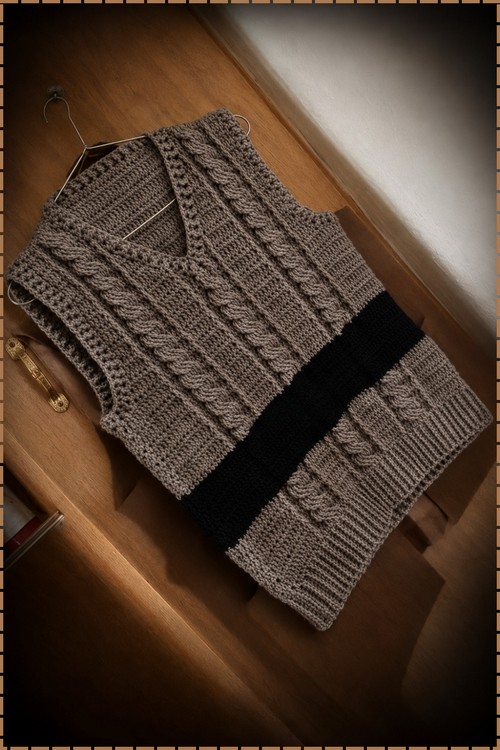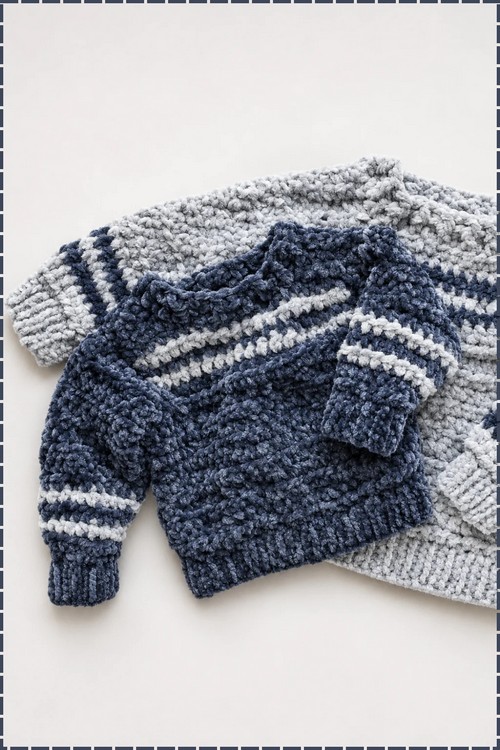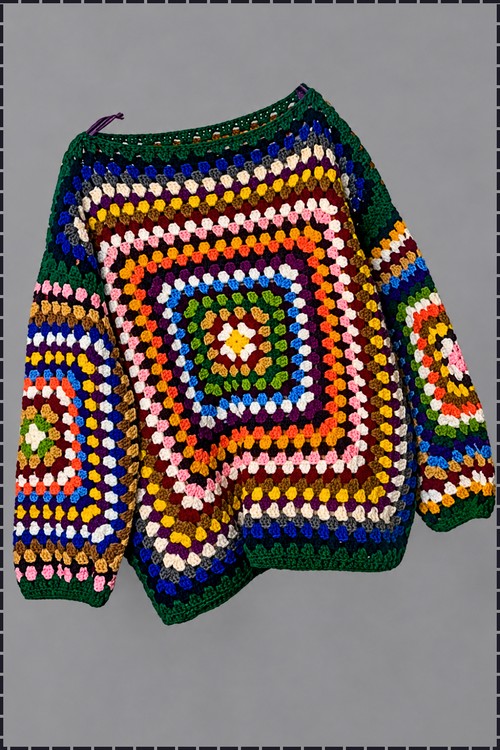
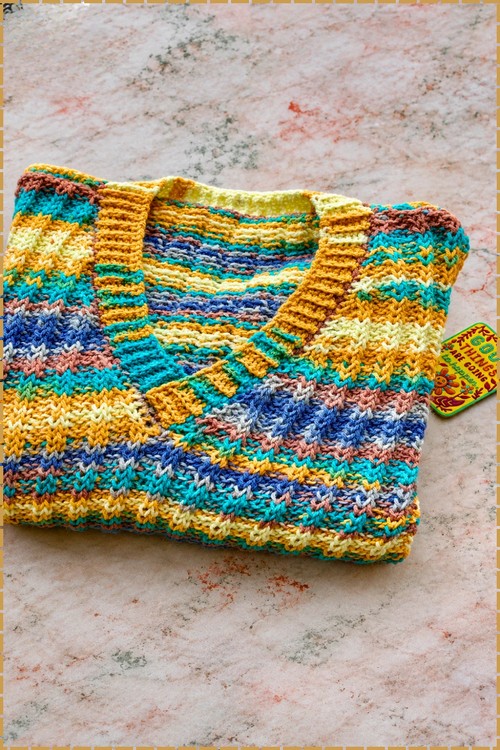
Variegated yarn in mustard, teal and cobalt turns this Tunisian crochet sweater for men into a bright striped pullover with a mustard ribbed V-neck. Your dad, brother or partner can wear the men’s crochet pullover over a collared shirt at work or with jeans on cold weekends.
Picture a chilly November morning, coffee in hand, and the man in your life pulling on a ribbed V-neck sweater you made with your own hands. That moment is exactly why this Tunisian crochet sweater for men deserves a spot in your queue.
Tunisian Crochet Sweater Men

The 2×2 Tunisian rib gives the body a structured, knit-like texture that reads classic rather than crafty, while the sleeves switch to smooth Tunisian knit stitch for an easy fit. Everything is built from flat pieces: a front with a deep V, a straight back, and two gently flared sleeves, all joined and finished with a neat ribbed neckline.
Why I love this one: it looks like a store-bought knit, yet every stitch is crochet.
Materials and Tools
This sweater is written for size XL and uses a DK or light worsted weight yarn, category 3, which keeps the fabric warm without making it bulky. The sample uses Ice Yarns, about five balls of 100 g and 360 meters each, for a total of roughly 1800 meters. A 30 cm Tunisian hook is long enough for the panels because the ribbing works widthwise and the loops pick up along its edge. You also need two standard hooks, one for the bottom ribbing and seams, and a smaller one that gives the neckline band a tighter, crisper finish.
- DK or light worsted weight yarn, category 3, about 1800 meters for size XL
- 6.0 mm Tunisian crochet hook, 30 cm long
- 6.0 mm standard crochet hook for the ribbing and seaming
- 5.0 mm standard crochet hook for the neck ribbing
- Stitch markers
- Darning needle
- Measuring tape
- Scissors
Stitch Guide
The body relies on two Tunisian stitches, and getting comfortable with both on a small swatch makes the front panel go smoothly. Tunisian knit stitch creates a V-shaped column, while Tunisian purl stitch adds a raised bump, and alternating them in pairs produces the deep 2×2 rib that defines this sweater. Each row is a set of two passes: a forward pass that loads loops onto the hook and a return pass that works them off. You never turn the work. Keep your purl stitches as relaxed as your knits so the rib columns stay even and the fabric does not pull.
- Tunisian knit stitch: insert the hook front to back between the front and back vertical bars, yarn over, and pull up a loop
- Tunisian purl stitch: bring the yarn to the front, insert the hook right to left under the front vertical bar, move the yarn to the back, yarn over, and pull up a loop
- Return pass: chain 1, then yarn over and pull through 2 loops at a time until 1 loop remains
- Edge stitch: insert the hook under both side loops of the last stitch to pull up the final loop
- Slip stitch bind off: work each stitch in pattern, then pull the new loop straight through the loop on the hook
The Pattern
Front Panel

Bottom Ribbing
- Using the 6.0 mm standard hook, make a slip knot and chain 13
- Work 1 single crochet into the 2nd chain from the hook and into every chain across (12 single crochets)
- Chain 1 and turn, work 1 single crochet through both loops of the first stitch, single crochet in the back loop only of the next 10 stitches, and work 1 single crochet through both loops of the last stitch
- Repeat that ribbing row until the ribbing is complete (94 rows)
Main Body
- Switch to the 6.0 mm Tunisian hook and turn the ribbing horizontally
- Treat the loop on your hook as the first stitch, then pick up one loop at the end of each single crochet row along the long edge (94 stitches)
- Work the foundation return pass: chain 1, then yarn over and pull through 2 loops across until exactly 1 loop remains
- For the first pattern row, count the loop on the hook as the first stitch, then work Tunisian knit stitch in the next 2 stitches
- Work Tunisian purl stitch in the next 2 stitches
- Continue alternating 2 Tunisian knit stitches and 2 Tunisian purl stitches across
- Work the last edge stitch by inserting the hook under both side loops
- Work a return pass: chain 1, then yarn over and pull through 2 loops across
- Repeat the pattern row and return pass to build the 2×2 rib, working through Row 54, when the panel should measure roughly 16 inches before neck shaping

V-Neck Shaping
- Find the center of the work and place a stitch marker there (47 stitches on each side)
- From here, work the left and right shoulders at the same time using two separate balls of yarn
- Setting row: work the 2×2 pattern across the first stitches for the left shoulder, then drop that yarn (47 stitches)
- Join a new ball of yarn directly after the marker and work the 2×2 pattern across the remaining stitches for the right shoulder (47 stitches)
- Work the return pass with the new yarn until you reach the center, then drop it
- Pick up the original yarn and complete the return pass across the left shoulder
- Decrease row, left shoulder: work in pattern until 3 stitches remain before the center gap, insert the hook into the 3rd and 2nd to last stitches together, yarn over, and pull up one loop, then work the final center stitch normally
- Decrease row, right shoulder: insert the hook into the 2nd and 3rd stitches together, yarn over, and pull up one loop, then work in pattern to the end
- Work the return pass normally on both shoulders (46 stitches on each side)
- No decrease row: work the pattern across both shoulders with no decreases
- Continue alternating decrease rows on even rows and no decrease rows on odd rows through Row 90 (29 stitches on each shoulder)
- Bind off by working each stitch in its knit or purl pattern and pulling the loop straight through the loop on the hook
- Fasten off, leaving a long tail for sewing
Back Panel

Bottom Ribbing
- Make a ribbing exactly like the front: chain 13 and work back loop only single crochet with regular edge stitches (94 rows)
Main Body
- Switch to the 6.0 mm Tunisian hook and pick up loops across the ribbing edge (94 stitches)
- Work the same 2 Tunisian knit stitch and 2 Tunisian purl stitch rib pattern
- Work straight with no neckline decreases (90 rows)
- Bind off with the slip stitch method used on the front and fasten off
Sleeves

Cuff
- Using the 6.0 mm standard hook, chain 13
- Work the same ribbing as the body, back loop only single crochet with regular single crochet on the edge stitches (40 rows)
Sleeve Body
- Switch to the 6.0 mm Tunisian hook and pick up one loop per single crochet row evenly across the top of the cuff (40 stitches)
- Work a standard return pass
- Work the whole sleeve in Tunisian knit stitch only
- Work Rows 1 to 4 evenly in Tunisian knit stitch (40 stitches)
- Increase row, start: insert the hook into the horizontal gap between the 1st and 2nd vertical bars, yarn over, pull up a loop, then work Tunisian knit stitch across
- Increase row, end: insert the hook into the gap between the 2nd to last and final stitch, yarn over, pull up a loop, then work the final edge stitch normally
- Continue in Tunisian knit stitch, working an increase row with 1 stitch added at each end every 4th or 5th row, so the sleeve flares gradually toward the shoulder through Row 90
- Bind off with the slip stitch method
- Make a second identical sleeve
Assembly
Shoulder Seams
- Using the 6.0 mm standard hook, lay the front and back panels right sides together
- Slip stitch the shoulder stitches together on the left and right sides using the long tails (29 stitches per shoulder)
Attaching the Sleeves
- With the wrong sides facing out, fold each sleeve in half lengthwise to find the top center point
- Pin that center point to the shoulder seam
- Slip stitch with a crochet hook, or sew with a darning needle, along the top of the sleeve and the armhole opening
- Repeat for the second sleeve
Side Seams
- Fold the sweater in half at the shoulders with the wrong side facing out
- Starting at a sleeve cuff, slip stitch down the underside of the arm
- Turn at the armpit and continue seaming straight down the body side to the bottom ribbing
- Repeat on the other side
V-Neck Ribbing
Base Round
- Turn the sweater right side out and switch to the 5.0 mm standard hook
- Join the yarn at the bottom center point of the V-neck
- Single crochet evenly all the way around the neck opening
- Slip stitch into the first single crochet to join
Neckband
- Chain 7
- Work 1 single crochet into the 2nd chain from the hook and into the next 5 chains (6 single crochets)
- Slip stitch into the next 2 stitches along the neck edge to anchor the band, then turn
- Single crochet in the back loop only across 5 stitches, then work a regular single crochet in the last stitch
- Chain 1 and turn
- Work a regular single crochet in the first stitch, then single crochet in the back loop only of the next 5 stitches
- Slip stitch into the next 2 stitches along the neck edge and turn
- Repeat these band rows all the way around the neck opening
Finishing
- When you return to the bottom of the V, cut a long tail
- Use a darning needle to sew the two ends of the band together, overlapping them slightly to form a sharp V point at the center front
- Weave in all remaining ends
Tips for a Polished Fit
A men’s sweater is a big project, so a few habits along the way protect all those hours of work. Measure the front panel at Row 54 against the target of roughly 16 inches, because that is your best moment to catch gauge problems before the neck shaping begins. When working both shoulders at once, keep the two balls on opposite sides of you so the strands never twist. Count your shoulder stitches every few decrease rows to confirm both sides stay even, and lightly block every piece before seaming so the rib columns line up cleanly.
- Check the panel height at Row 54 before starting the V-neck
- Keep the two shoulder yarns well apart to prevent tangling
- Count both shoulders regularly during the V-neck decreases
- Block the panels and sleeves before joining for straighter seams
- Pin the sleeve centers carefully so both sides hang evenly
Yarn Substitution
Any DK or light worsted weight category 3 yarn can stand in for the original, provided it gives you a similar fabric with your 6.0 mm Tunisian hook. For a men’s sweater, a wool or wool blend adds warmth, memory, and rib definition, while a soft acrylic keeps it washable and affordable for everyday wear. Avoid very slippery yarns, which can blur the knit and purl columns, and very fuzzy yarns, which hide the rib texture. Since the pattern totals about 1800 meters for size XL, buy all of your yarn in the same dye lot.
- Wool or wool blends for warmth and crisp ribbing
- Soft acrylic for easy care and everyday wear
- Avoid slippery or very fuzzy yarns that hide the rib
- Buy every skein from one dye lot
Customization Ideas
The simple panel construction leaves plenty of room to personalize the sweater. Contrast colors on the bottom ribbing, cuffs, and neckband give it a classic varsity feel, while a single heathered neutral keeps it smart enough to wear with a collared shirt. You can lengthen or shorten the body by adjusting rows before the V-neck shaping begins, and the sleeve length changes the same way. For a relaxed look, work a few extra rows into the ribbing for a deeper waistband and cuffs, which also adds a cozy, chunkier detail.
- Work the ribbing, cuffs, and neckband in a contrast color
- Choose a heathered neutral for a smart, versatile sweater
- Adjust body and sleeve length with extra or fewer rows
- Make deeper cuffs and waistband for a relaxed style
Frequently Asked Questions
These answers cover the questions makers ask most often about this men’s Tunisian sweater, especially around sizing, the double-yarn shoulder method, and the neck finish. Because the whole garment is built from flat panels, most issues are easy to spot and fix before seaming. Take time to read through these before starting the front panel, since the V-neck section is where the majority of questions come up. With a little patience through those shoulder rows, the rest of the sweater moves along steadily and comes together surprisingly quickly at assembly.
What size is this men’s sweater?
The pattern is written for size XL, with 94 stitches across each panel and a front measuring roughly 16 inches before the V-neck begins.
Why do I need two balls of yarn for the V-neck?
Working both shoulders with separate yarns lets you shape the left and right sides at the same time, so the V stays even and both shoulders finish at the same height.
Why is the neckband worked with a smaller hook?
The 5.0 mm hook makes a tighter, firmer band, which helps the V-neck keep its shape and prevents the neckline from stretching out over time.
Can I sew the seams instead of crocheting them?
Yes. The sleeves can be attached with a darning needle, and many makers sew the side seams too for a flatter, less visible finish.