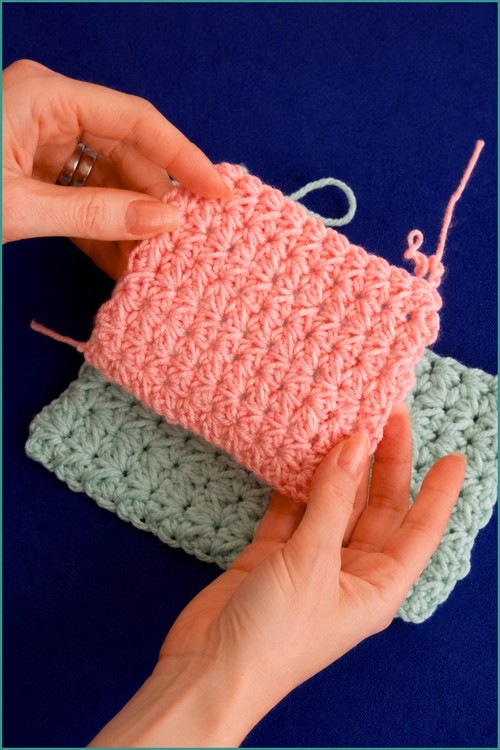
Lace crochet has a way of stopping people mid-scroll. Open shell stitch is one of the patterns I come back to whenever someone asks me what looks impressive but is not actually punishing to make. The construction is logical — a foundation row that lays down the shells and their anchor points, then three rows that open the structure, redistribute the stitches, and close back into a new shell.
Crochet Open Shell Lace Stitch
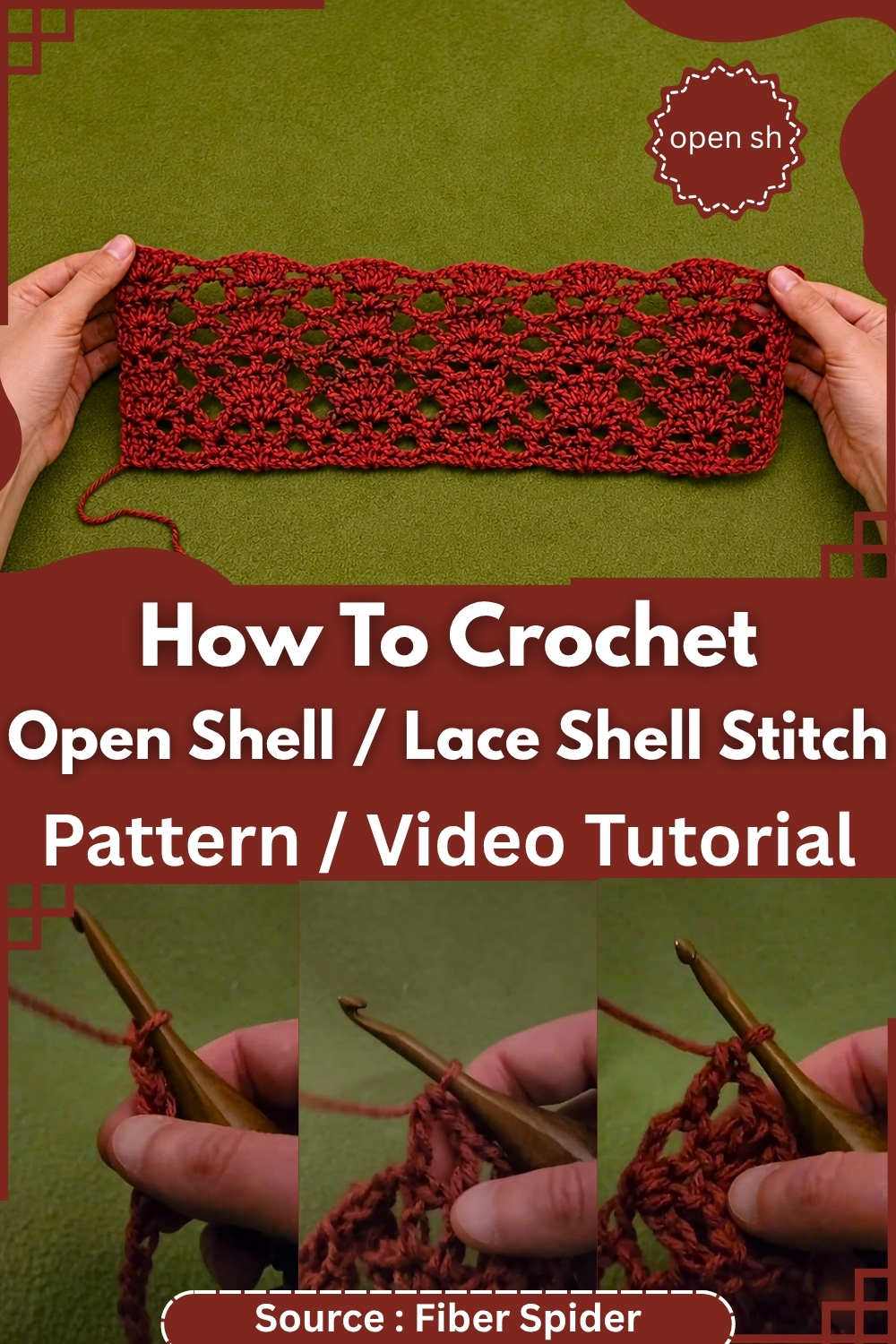
After the first repeat clicks, the pattern becomes readable in the fabric itself. You start to see where the next shell belongs before you even count. That moment of recognition is one of the quiet pleasures of lace crochet, and this stitch earns it relatively quickly.
Materials and Tools
- Medium weight yarn
- 6 mm (J) crochet hook
- Scissors
- Yarn needle for finishing
Difficulty and Time
Difficulty: Intermediate Best for: Makers comfortable with double crochet and chain spaces who want to move into lace patterns. The three-row repeat is consistent and becomes intuitive within a few pattern cycles. Time: Varies by project size. The repeat is three rows, which works up at a steady pace once established.
Abbreviations
- ch — chain
- sc — single crochet
- dc — double crochet
- st — stitch
- rep — repeat
Beginner Notes
- This pattern uses only single crochet, double crochet, and chains — no specialty stitches. What makes it lace rather than plain crochet is the spacing: intentional skips, chain loops of specific lengths, and shell clusters that fan open across the fabric. If you are new to lace, these tips will help before you begin:
- Chain tension is everything. Lace lives and dies by its chain spaces. Keep every chain relaxed. Tight chains close up the open structure and make the finished fabric look compressed rather than airy.
- Count as you go. The pattern multiple is strict — your foundation chain must be a multiple of 12, plus 4. One chain off, and the repeat will not close evenly at the row end. Count twice before starting Row 1.
- Use stitch markers. While you are learning the repeat, placing a marker at the center sc of each shell section will help you locate anchor points quickly in the following row.
- Blocking transforms lace. The stitch pattern looks good off the hook. It looks significantly better after wet blocking. Pinning the piece flat and letting it dry opens the shells, evens the chain loops, and reveals the full lace structure.
Yarn and Customization
Medium weight yarn on a 6 mm hook gives this stitch a defined, substantial drape — well suited to wraps, shawls, and home accessories. For a finer lace with more delicacy, a DK or sport weight yarn on a smaller hook creates smaller shells with more visible openwork between them. Cotton brings out the stitch definition most crisply; wool and wool blends give warmth and softness at the cost of some clarity in the lace structure; cotton-acrylic blends offer a practical middle ground.
Color works simply here: solid and tonal yarns show the shell motif at its best. Slow-shifting gradients can be beautiful. Fast-changing variegated yarns compete with the lace and reduce its visual impact.
Project ideas: rectangular shawls and wraps, baby blankets, table runners, tote bag panels, and wide scarves all suit this stitch well.
The Pattern
Pattern Multiple
- Foundation chain must be a multiple of 12.
- Add 4 extra chains at the end.
Construction Overview
- Row 1 is the foundation — it establishes the shell structure and the chain-5 loops that anchor the following rows.
- Rows 2 and 3 open the shell framework into lace.
- Row 4 rebuilds the shell motifs, closely resembling Row 1.
- After Row 4, the repeat runs continuously: Rows 2, 3, and 4.
- Still getting the hang of reading crochet patterns? That’s completely okay, the video tutorial below breaks everything down in a simple, beginner-friendly way!
Row 1 — Foundation Row
- In the 4th chain from the hook, work 3 double crochets. (The skipped chains count as a double crochet.)
- Chain 2.
- Skip 3 chains. Single crochet into the 4th chain.
- Chain 5.
- Skip 3 chains. Single crochet into the 4th chain.
- Chain 2.
- Skip 3 chains. Work 5 double crochets into the 4th chain.
- Repeat this sequence across the row.
- Finish by working 3 double crochets into the final chain.

This row creates the foundation shells and open spaces. The chain-5 loops become the anchor points in Row 2. Keep shell stitches evenly sized for a consistent appearance.
Row 2
- Chain 4 and turn. (The chain 4 counts as a double crochet and a chain-1 space.)
- Skip the first stitch.
- Double crochet into the next stitch.
- Chain 1.
- Continue working double crochets separated by chain-1 spaces across the shell.
- Chain 2.
- Single crochet into the chain-5 space.
- Chain 2.
- Continue repeating across the row.
- Finish by working across the ending shell group.
This row begins opening the shell structure. Keep chain spaces consistent — they create the flexibility and drape that define the lace appearance.

Row 3
- Chain 5 and turn. (The chain 5 counts as a double crochet and a chain-2 space.)
- Double crochet into the next double crochet.
- Chain 2.
- Continue across the shell stitches.
- Skip the spaces and single crochet from the previous row.
- Move directly to the next shell and work a double crochet.
- Continue working double crochets separated by chain-2 spaces across the row.
This row expands the lace effect. The larger chain-2 spaces create the characteristic open appearance. After this row the stitch structure should begin to look more defined.

Row 4
- Chain 3 and turn. (The chain 3 counts as a double crochet.)
- Work 2 more double crochets into the first stitch.
- Chain 2.
- Single crochet into the second chain-2 space of the shell.
- Chain 5.
- Single crochet into the next chain-2 space.
- Chain 2.
- Skip the double crochet.
- Work 5 double crochets into the next double crochet.
- Continue repeating this sequence across the row.
- Finish with 3 double crochets into the top of the final stitch.
This row recreates the shell motifs. The completed row should closely resemble Row 1. Once Row 4 is finished, the repeat is fully established.
Repeat Sequence
- Repeat Row 2.
- Repeat Row 3.
- Repeat Row 4.
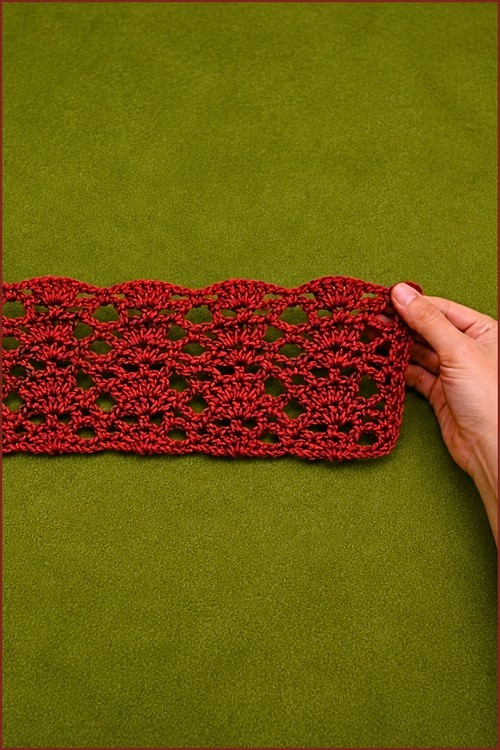
- Continue repeating these three rows until the project reaches the desired length.
Tips
- Keep chain spaces relaxed throughout. Tight chains are the most common problem in lace crochet and the hardest to fix after the fact. If the fabric is puckering or the shells look compressed, loosen your chain tension in the next row before continuing. You cannot fix tight chains by pulling on the finished fabric.
- Count shell stitches regularly, not just at the end of rows. Catching a missed or extra double crochet within a shell early is easy. Catching it two rows later means unpicking back through chain spaces. A quick count after each shell as you work Row 1 and Row 4 will save significant time.
- Verify your beginning and ending stitches in every row. Uneven edges almost always come from inconsistent row starts or finishes — skipping the turning chain count, or missing the final anchor stitch. The turning chain lengths differ in each row (ch 4, ch 5, ch 3), so refer back to the instructions until the pattern is familiar.
- Stretch the fabric occasionally as you work. Gently pulling the piece lengthwise and widthwise every few rows lets you see the lace structure developing and spot any tension inconsistencies before they become a pattern.
- Block before judging the finished result. Raw off-the-hook lace looks compressed. Wet blocking — soaking the piece, pinning it flat to dimensions, and letting it dry fully — opens every shell, straightens the chain loops, and reveals the stitch pattern as it is meant to look. The difference is significant enough that blocking is not optional for lace; it is part of the pattern.
FAQ
1. What does “multiple of 12 plus 4” mean for the foundation chain? It means your total chain count needs to be divisible by 12, with 4 added on top. For example: 24 + 4 = 28, or 36 + 4 = 40. The 12-stitch multiple is what each pattern repeat occupies across the row. The extra 4 chains account for the turning chain at the start of Row 1. If your chain is not an exact multiple of 12 (before the extra 4), the repeat will not close evenly at the row end.
2. Why do the turning chains change length between rows? Each row starts with a different structure. Row 2 begins with a dc and a chain-1 space, so the turning chain is 4 (3 for the dc + 1 for the space). Row 3 begins with a dc and a chain-2 space, so the turning chain is 5. Row 4 begins with just a dc, so the turning chain is 3. The turning chain substitutes for the first stitch of each row, and its length needs to match the height and structure of what it replaces.
3. My shells are uneven — some look wider than others. What went wrong? Recount the double crochets in each shell. The pattern uses 3-dc shells at the row start and end (foundation and Row 4), and 5-dc shells in the interior. Accidentally adding or dropping a dc within a shell is the most common cause of uneven width. If the counts are correct but the shells still look uneven, the issue is chain tension — some chain-2 or chain-5 loops are tighter than others.
4. Can I use a lighter weight yarn for a finer lace? Yes. DK or sport weight on a correspondingly smaller hook produces smaller, more intricate shells with more visible openwork between them. The pattern repeat and row structure stay the same. Fingering weight works too and creates a very delicate result, though the fine yarn makes it harder to see the chain spaces while working — use good light and stitch markers to track placement.
5. Is blocking really necessary, or is it optional? For lace patterns, blocking is functionally part of the pattern. The open shell stitch has a finished, complete look off the hook, but the shells are compressed and the chain spaces are not fully open. Wet blocking — soaking the piece, pinning it to size, drying flat — changes the appearance significantly. If you are making this for a gift or any purpose where the final look matters, block it. If it is a practice swatch, skip it. For any finished project, block.